
Lithium vs Lead Acid Batteries: Which is Better for Indian Homes?
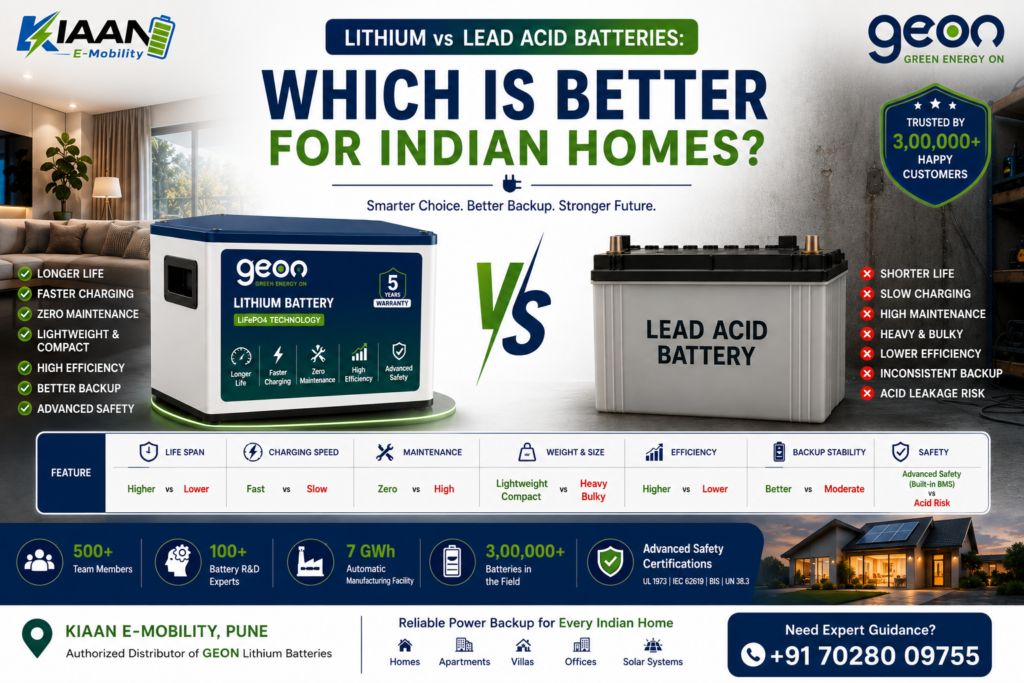
Power backup has become essential for Indian homes due to increasing electricity usage, summer power cuts, and work-from-home requirements. Whether it’s a flat in Pune, a villa, or a farmhouse, choosing the right inverter battery directly affects comfort, efficiency, and long-term cost.
The biggest question homeowners face today is:
Should you choose a Lithium Battery or a Lead Acid Battery?
In this guide, we compare both technologies in detail to help Indian homeowners make the right decision.
What is a Lead Acid Battery?
Lead acid batteries are traditional inverter batteries that have been used in Indian homes for many years.
They use:
- Lead plates
- Sulfuric acid electrolyte
These batteries are commonly used because they are:
- Easily available
- Lower in initial purchase cost
However, they require regular maintenance and have certain performance limitations.
What is a Lithium Battery?
Lithium batteries are advanced energy storage systems designed for modern power backup needs.
Most modern residential lithium batteries use:
LiFePO4 (Lithium Iron Phosphate) technology
GEON Lithium Batteries use durable LiFePO4 prismatic cells with advanced BMS technology for improved efficiency and longer backup.
Lithium batteries are becoming increasingly popular in:
- Homes
- Apartments
- Offices
- Solar systems
Lithium vs Lead Acid Batteries — Complete Comparison
1.Battery Life
Lead Acid Battery
- Typically lasts around 2–3 years depending on usage and maintenance
Lithium Battery
- Designed for significantly longer operational life
GEON lithium batteries are designed for long-lasting performance and improved durability.
Winner:
✅ Lithium Battery
2.Charging Speed
Lead Acid
- Charges slowly
- Can take many hours for full charging
Lithium
- Faster charging capability
- Better for areas with frequent power cuts
GEON lithium batteries support faster charging and higher efficiency.
Winner:
✅ Lithium Battery
3.Maintenance
Lead Acid
Requires:
- Regular water topping
- Cleaning terminals
- Maintenance checks
Lithium
- Zero maintenance
- No water filling
- No acid handling
GEON lithium batteries are specifically designed as maintenance-free solutions.
Winner:
✅ Lithium Battery
4.Weight & Space
Lead Acid
- Heavy
- Bulky
- Occupies more installation space
Lithium
- Compact design
- Lightweight construction
GEON batteries are designed with smaller size and lower weight for easier placement at home.
Winner:
✅ Lithium Battery
5.Efficiency
Lead Acid
- Lower energy efficiency
- Higher power loss
Lithium
- Better energy utilization
- Higher efficiency
GEON lithium systems are designed with improved efficiency and lower self-discharge rates.
Winner:
✅ Lithium Battery
6.Backup Performance
Lead Acid
Performance may reduce over time, especially during:
- Summer heat
- Heavy appliance usage
Lithium
Provides:
- Stable backup
- Better performance during repeated usage cycles
GEON lithium batteries are suitable for home UPS, solar systems, and inverter applications.
Winner:
✅ Lithium Battery
7.Safety Features
Lead Acid
- Acid leakage risk
- Gas emission possibility
- Requires ventilation
Lithium
Modern lithium batteries include advanced safety systems.
GEON batteries include safety standards such as:
- UL 1973
- IEC 62619
- BIS
- UN 38.3 certifications
Winner:
✅ Lithium Battery
Quick Comparison Table
| Feature | Lead Acid Battery | Lithium Battery |
|---|---|---|
| Life Span | Lower | Higher |
| Charging Speed | Slow | Fast |
| Maintenance | High | Zero |
| Weight | Heavy | Lightweight |
| Efficiency | Lower | Higher |
| Space Saving | No | Yes |
| Backup Stability | Moderate | Better |
| Modern Compatibility | Limited | Excellent |
Why Indian Homes Are Moving Towards Lithium
Indian households today use:
- Wi-Fi routers
- Smart TVs
- Refrigerators
- Work-from-home setups
- CCTV systems
- Multiple fans & appliances
These modern energy demands require:
- Faster charging
- Stable backup
- Better efficiency
Lithium batteries are better suited for these changing requirements.
Is Lithium Battery Worth the Investment?
While lithium batteries may have a higher initial cost compared to lead acid batteries, homeowners benefit from:
- Longer operational life
- Lower maintenance cost
- Better performance
- Reduced replacement frequency
Over time, this can provide better long-term value.
Why Choose GEON Lithium Batteries?
GEON offers advanced lithium battery solutions backed by:
- 500+ team members
- 100+ battery R&D experts
- 7 GWh automatic manufacturing facility
- 3,00,000+ batteries in the field
GEON solutions are designed for:
- Residential backup
- Telecom
- Solar applications
- Energy storage systems
Best Applications for Lithium Batteries
Residential Homes
- Apartments
- Villas
- Farmhouses
Commercial Spaces
- Shops
- Clinics
- Offices
Solar Backup Systems
- Solar inverter setups
- Hybrid power systems
Final Verdict: Which Battery is Better?
If you want:
- Modern technology
- Zero maintenance
- Better efficiency
- Longer backup
- Compact design
Then Lithium Batteries are the smarter choice for modern Indian homes.
Lead acid batteries may still work for basic usage, but lithium batteries are becoming the preferred long-term solution.
Looking for Lithium Batteries in Pune?
📍 Visit Kiaan E-Mobility, Pune
Authorized Distributor of GEON Lithium Batteries
Get expert guidance for:
- Home UPS batteries
- Lithium inverter batteries
- Solar battery systems
- Residential backup solutions
FAQ
Lithium batteries offer faster charging, longer life, zero maintenance, compact size, and higher efficiency compared to traditional lead acid batteries.
Yes, lithium batteries are highly suitable for home UPS and inverter systems because they provide reliable backup, faster charging, and require very low maintenance.
GEON Lithium Batteries are designed for residential applications and are suitable for home UPS, solar systems, and inverter backup solutions.
Yes, GEON Lithium Batteries are compatible with most home UPS and inverter systems including sine wave and solar inverters.