
Why Pune's Monsoon Power Cuts Need a Lithium Battery, Not Lead-Acid
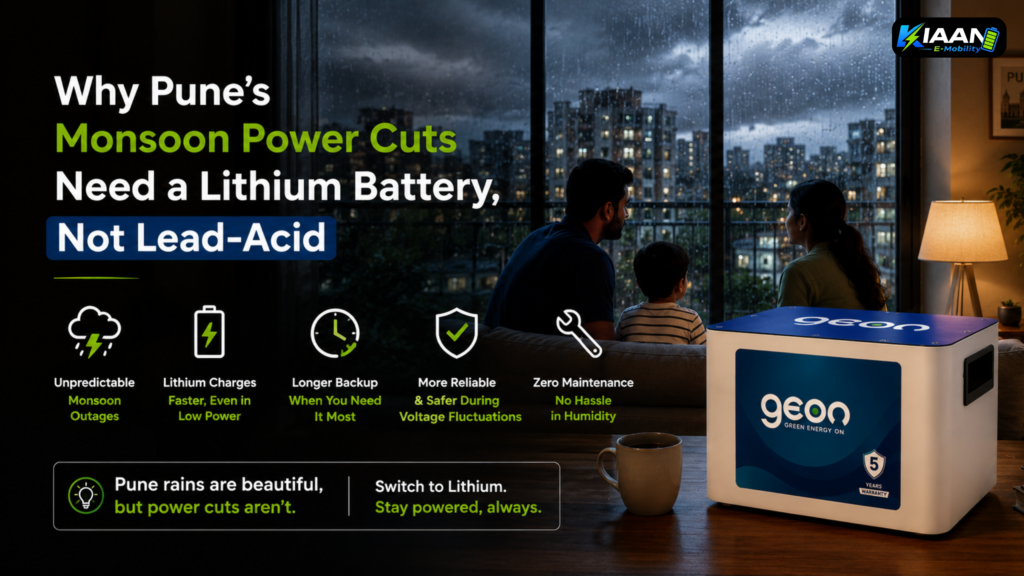
Ask anyone in Pune what June to September looks like, and “power cuts” comes up fast.
Waterlogging near substations, tree falls on overhead lines, and grid load fluctuations mean areas like Hadapsar, Wakad, Kothrud, and the outskirts near Talegaon and Ranjangaon regularly deal with outages that last anywhere from twenty minutes to several hours — often repeating multiple times in a single evening. This pattern exposes a weakness in lead-acid batteries that most people don’t notice until the monsoon actually hits: they simply can’t recharge fast enough between cuts, and by the third outage of the night, the backup that was supposed to save you has quietly stopped working.
The Problem With Lead-Acid During Back-to-Back Outages
A lead-acid battery that’s just been drained needs a long, slow charge to recover meaningfully. If the power comes back for 45 minutes and then cuts again — a very normal monsoon evening in Pune — a lead-acid battery might only regain a small fraction of its capacity in that window. By the third or fourth cut of the night, it’s running on fumes, and your backup effectively stops working exactly when you need it most: during dinner, while the kids are trying to study, or right when the Wi-Fi router needs to stay up for a late work call.
This isn’t a rare edge case. It’s the standard pattern for most Pune neighbourhoods during peak monsoon weeks, and it’s the single biggest reason people call their electrician in September asking why the “new” battery from last year already feels weak.
Why Lithium Batteries Handle This Differently
GEON LiFePO4 batteries, distributed in Pune by Kiaan E-Mobility, charge up to 3x faster than lead-acid. That difference isn’t just a spec sheet number — it directly determines whether your battery has meaningfully recovered by the time the next cut arrives. In practice, this means:
- Faster recovery between cuts: Even short windows of grid power translate into real charge gained, not a token trickle that barely moves the needle.
- 95%+ charging efficiency: Less energy lost as heat during the charge cycle, so more of what the grid gives you actually gets stored and made available for the next outage.
- Stable performance across repeated cycles: Unlike lead-acid, which degrades faster when repeatedly drained and partially charged, LiFePO4 chemistry tolerates this pattern well — which matters because “partial drain, partial charge, repeat” is exactly what a monsoon night in Pune looks like, week after week for months.
Monsoon-Specific Reliability Concerns
Beyond charging speed, monsoon season raises two other issues where lithium has a clear edge over the battery most Pune homes already have installed:
Humidity and sealed design. Lead-acid batteries with vented caps are more exposed to moisture ingress and corrosion around terminals during Pune’s humid months, especially in ground-floor or basement installations where damp air lingers. GEON’s sealed LiFePO4 units are built to a higher ingress-resistance standard, reducing this risk considerably.
No water top-ups mid-season. Lead-acid batteries need periodic distilled water top-ups to function correctly. Forgetting this during a busy monsoon month — when everyone’s attention is on leaking roofs and flooded roads, not battery maintenance — is extremely common, and it directly shortens battery life and backup performance right when you need it most. LiFePO4 batteries need none of this upkeep.
Built for Longer, Harder Use
GEON batteries are rated for 3,000+ charge cycles, roughly ten times what a typical lead-acid battery survives. For Pune homes, where the monsoon alone can put a battery through dozens of drain-recharge cycles in a single season, this translates directly into a battery that’s still performing well years later — not one that needs replacing every monsoon or two, as many lead-acid users end up doing without quite realising why.
Certified for Safety, Not Just Performance
Every GEON battery Kiaan installs carries UL 1973, IEC 62619, BIS, and UN 38.3 certification, along with a 5-year warranty. During a season when electrical safety is already a heightened concern — damp walls, humidity, occasional water ingress in ground-floor utility areas — a sealed, certified battery is a meaningfully safer choice than an open lead-acid unit sitting in a wet corner.
Local Support When It Actually Matters
A battery installed by a distributor based two states away is of little help if something goes wrong mid-monsoon and you need a technician the same day, not next week. Kiaan E-Mobility is Pune-based, offering same-day demos and doorstep installation, with support that understands exactly which pockets of the city see the worst outages — from Hinjewadi’s IT corridor to the industrial belts near Chakan and Pimpri, and the outer residential stretches near Talegaon.
Monsoon season is precisely when backup power is tested hardest — and precisely when lead-acid batteries fall short due to slow recharge cycles and moisture vulnerability. A GEON LiFePO4 battery, installed and supported locally by Kiaan E-Mobility, is built to recover fast between cuts and hold up across an entire season of Pune’s unpredictable rains, rather than quietly giving up by the third outage of the night.
Get monsoon-ready before the next outage hits. Book a free consultation with Kiaan E-Mobility, Pune’s local GEON battery partner.