
Lithium vs Lead-Acid Batteries: What Pune Homeowners Are Switching To
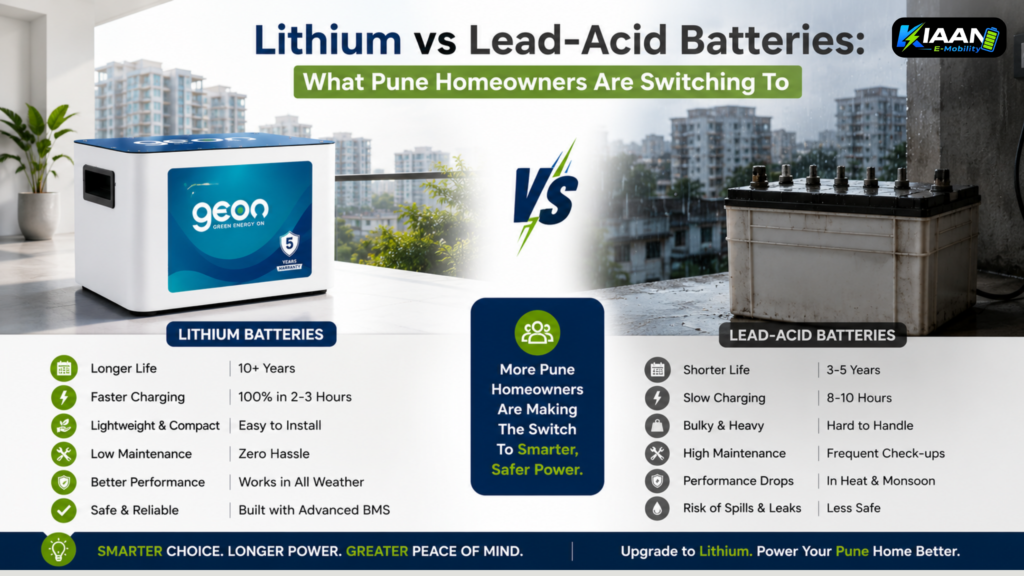
Every few years, Pune homeowners face the same decision: the old inverter battery has died, and it’s time to replace it. Until recently, that meant picking between a handful of similar-looking lead-acid batteries from whichever brand the local electrician recommended.
Increasingly, the more relevant question is a different one entirely — lithium or lead-acid? Here’s an honest, side-by-side look at how GEON’s LiFePO4 batteries, supplied locally by Kiaan E-Mobility, stack up against the lead-acid battery you’re probably about to replace.
Lifespan: 10x Longer With Lithium
This is the single biggest difference, and arguably the only one that matters if you only remember one thing from this article. A typical lead-acid inverter battery is rated for 300–400 charge cycles, which in real-world Pune conditions translates to roughly 2–3 years before performance noticeably drops and backup time starts shrinking. GEON LiFePO4 batteries are rated for 4,000+ cycles — around ten times longer. Over a decade of ownership, that’s the difference between replacing your battery three or four times versus once.
Weight and Size
Lead-acid batteries are heavy — often 30-40 kg for a mid-size unit — and bulky, largely because of the thick lead plates and liquid electrolyte inside. Moving one, even from the shop to your home, usually needs two people. LiFePO4 batteries are up to 60% lighter and considerably more compact for the same backup capacity, which matters whether you’re fitting one into a Pune apartment’s utility corner or simply want something a single technician can install without straining.
Charging Speed and Efficiency
Lead-acid batteries charge slowly and lose meaningful energy as heat during the process — you can often feel a lead-acid battery warm to the touch after a long charge cycle, which is wasted energy you paid for. LiFePO4 batteries charge up to 3x faster and operate at 95%+ efficiency. In everyday terms: after a power cut, your lithium battery is back to a useful charge level far sooner than a lead-acid battery would be, which matters enormously if you’re dealing with repeated short outages.
Maintenance
Lead-acid batteries need regular distilled water top-ups and occasional terminal cleaning to prevent corrosion buildup. Skip this for even a couple of months, and battery life drops fast — most people don’t realise how directly their maintenance habits determine how long the battery actually lasts. LiFePO4 batteries are sealed and maintenance-free — nothing to top up, nothing to clean, nothing to forget.
Safety
This is where the comparison matters most for anyone in an apartment or a home with young children. Lead-acid batteries release hydrogen gas during charging and can leak acid if damaged or overcharged, both genuine hazards in an enclosed space. LiFePO4 chemistry is inherently more thermally stable and doesn’t emit toxic fumes, which is why GEON batteries carry UL 1973, IEC 62619, BIS, and UN 38.3 safety certifications — standards also used in EV and telecom battery applications where safety margins are non-negotiable.
Cost: Upfront vs Lifetime
This is usually where the conversation stalls, and understandably so. Yes, a lithium battery costs more to buy today than a comparable lead-acid unit — sometimes noticeably more.
But priced out over its working life — factoring in that you’re not replacing it every 2-3 years, not buying distilled water every few months, and not losing efficiency to heat — GEON batteries work out 60–70% cheaper over their lifetime. For most Pune homeowners planning to stay in their current home for more than a few years, the lifetime math tips clearly toward lithium, even if the sticker price doesn’t.
Warranty
GEON batteries come with a 5-year warranty, notably longer than what most lead-acid brands in the local market offer — itself a signal of how much longer the underlying chemistry is expected to last, and how confident the manufacturer is in that performance.
So Which Should You Choose?
If you’re looking for the lowest possible upfront cost and don’t mind battery maintenance or a 2-3 year replacement cycle, lead-acid remains the cheaper immediate option, and there’s nothing wrong with choosing it if that’s genuinely your priority. But for most Pune households — especially those in apartments, those who’ve dealt with monsoon-season power cuts, or anyone who’d rather not think about their inverter battery for the next several years — GEON’s LiFePO4 batteries are exactly why more homeowners across the city are making the switch this year.
Backed by Local Support in Pune
Kiaan E-Mobility, as Pune’s authorised GEON distributor, offers a same-day demo so you can see the difference in person before deciding, along with doorstep installation and support based right here in the city — not a distant call centre reading from a script.
Curious what a lithium upgrade would cost for your home? Reach out to Kiaan E-Mobility for a free comparison quote against your current battery.